Problem 1:
Question a:
Algorithm
Sort the sizes so that a1≤a2≤...≤anA←∅ // the set of sizes selectedb←0 // the current bin sizeFor j = 1 To n If size j + the current bin size b ≤ bin size B add the current item to the bin b += size jreturn A Question b:

Counter example:
Sizes are a1 = 10, a2 = 4, a3 = 5, and the bin size is B = 10
If we first sort the the sizes to get the sizes in ascending
order we will get sizes = [4, 5, 10]. When we implement the greedy
algo we will get the max cardinality of sizes that is less than
the bin size which is a2 and a3, however this is not the maximum quantity.
The issue is that we took the smallest elements first and did not care about
the elements sizes. We should have chosen the largest size 10, but we already
reached the bin size when we got to it. To solve this issue we should have
sorted the sizes in descending order first and then greedily choose the largest
sized elements that would fit in the bin.
Problem 2:
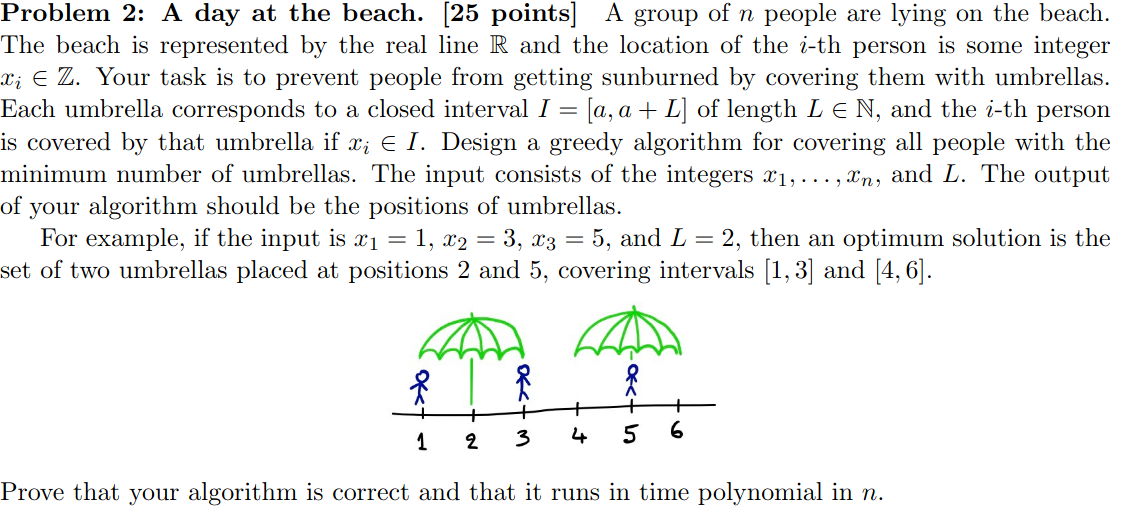
Algorithm
Sort the position of each person such that x1≤x2≤...≤xnU←∅ // set of umbrella positionsi←0 //index of current uncovered personL← length of the umbrellawhile i≤n current person = xi umbrella position = current position+2L Add the umbrella position to the set U umbrella start = umbrella position−2L umbrella end = umbrella position+2L while i≤n and umbrella start≤xi≤umbrella end i += 1return U Proof
Let the leftmost uncovered person be at position x_1. The algo
will then place the first umbrella at the position x_1 + L/2, covering
the interval [x_1, x_1 + L].Any optimal solution must have some umbrella covering the
person at x_1 as well as cover the same interval [x_1, x_1 + L]
Among all valid positions, placing the umbrella at x_i + L/2 is optimal because it still
covers the person at x_1 and it covers any additional uncovered intervals [x_i, x_i + L] that extend
as far right as possible.
The algorithm will run in O(n log(n)) since we are first sorting and then
looping through each persons position once.
Problem 3:

a.) Algorithm
Sort the items in descending order using the value-to-weight ratio w1v1≤w2v2≤...≤wnvnV←0C←WFor j = 1 To n If the C == 0 break out of the loop (knapsack is full) If the entire item fits into the bag wi≤C amount added=1 entire item Else amount added=wi weight of itemC the amount of weight left to reach the total weight C −=amount added×wj V +=amount added×vjreturn V b.) Proof
Prove that the greedy solution G is optimal by showing that we can
transform any optimal solution O into the greedy solution without losing
value.
Let i be the first item where G and O take different amounts.
Since G is greedy, it takes as much as possible of each item in order.
So G must take more of item i than O does initially.
Since, both solutions use exactly the same total weight, O must
be taking more of some later smaller items. We can create a new solution
from O which we can call O’ that will exchange its lower values with
higher values from G (the greedy solution). This will always give O’ >= to O
and since we converted O’ into G this proves that G is optimal.
c.) Runtime of Algorithm
Complexity:
O(n+log(n))=O(nlog(n)) Problem 4
a.) Algorithm
Sort the jobs by profit in descending order such that P1≥P2≥...≥PnM← find the max deadline djT← create boolean array the size of the max deadline initialized with all false valuesS← initialize empty scheduleFor each job dj in sorted order For time slots t from min(dj,M) down to 1 if time slot T[t]==false T[t] = true Add the job to the schedule Sreturn the schedule S b.) Proof
I will prove that the greedy solution G is optimal by showing that the
optimal solution O can be transformed into the greedy solution.
Case 1: G’s schedule is the same as O’s
Case 2: G’s schedule is different from O’s meaning there exits some job in
O that is not in G. Also there is some job in G that is not in O.
Let j be the job with highest profit among all jobs in G but not in O
Since our greedy algorithm selected j, there was an available time slot for j when we considered it.
However, since j is not in O, that time slot in O must either be:
- Empty
- Occupied by some other job k
Empty case
If the time slot is empty than we can add job j to this empty slot,
creating schedule O’ with profit(O’) = profit(O) + p_j > profit(O).
This contradicts optimality of O.
Occupied by some other job k case
The time slot is occupied by job k in O.
Since our greedy algorithm considered jobs in decreasing profit order,
and j was selected while k was not (in our algorithm’s execution), we know that either:
- p_j > p_k
- p_j = p_k and j was considered before k
We can create schedule O’ by replacing job k with job j.
Since p_j ≥ p_k, we have profit(O’) ≥ profit(O).
We can repeat this exchange process until O becomes identical to G.
Since each exchange maintains or improves the profit, the final schedule G has profit ≥ profit(O).
Therefore, our greedy algorithm produces an optimal solution.
c.) Runtime of Algorithm
Complexity:
O(n log(n)+(n×n))=O(n2)