Problem 1
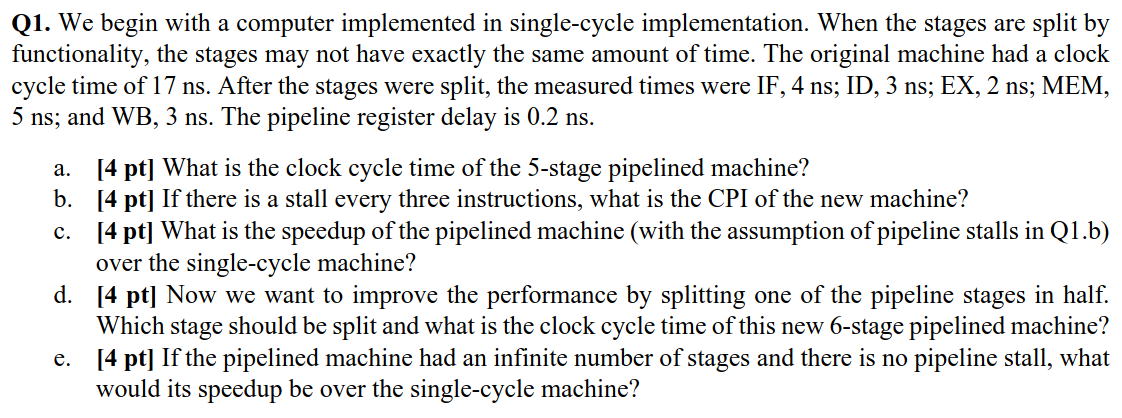
a.)
What is the clock cycle time of the 5-stage pipelined machine?
- The slowest stage is
MEM=5ns + register delay 0.2nsmeaning it will take5.2nsfor each stage to complete. The clock cycle time is therefore5.2ns.
Answer: 5.2 ns
b.)
If there is a stall every three instructions, what is the CPI of the new machine?
- 1 instruction is executed per cycle
- stalls add extra cycle where no instruction completes
- 3 instructions + 1 stall = 4 total cycles
- 3 instructions completed
- CPI = cycles/instructions = 4/3 = 1.33
Answer: CPI = 1.33
c.)
What is the speedup of the pipelined machine (with the assumption of pipeline stalls in Q1.b) over the single-cycle machine?
Old Machine
New Machine
Speedup
Answer: 2.45x
d.)
Now we want to improve the performance by splitting one of the pipeline stages in half. Which stage should be split and what is the clock cycle time of this new 6-stage pipelined machine?
- The longest stage
(MEM=5 ns)should be split in half in order to improve performance
Clock cycle time of new 6-staged machine:
- The slowest stage is
IF=4ns + register delay 0.2nsmeaning it will take4.2nsfor each stage to complete. The clock cycle time is therefore4.2ns
Answer: 4.2ns
e.)
If the pipelined machine had an infinite number of stages and there is no pipeline stall, what would its speedup be over the single-cycle machine?
- With an infinite number of stages we would approach a clock cycle time of approximately
0. - The register delay of
0.2 nswould be the limit for clock cycle time. - Therefore, the speedup over the single cycle machine would be
Speedup
Answer: 85x
a.)
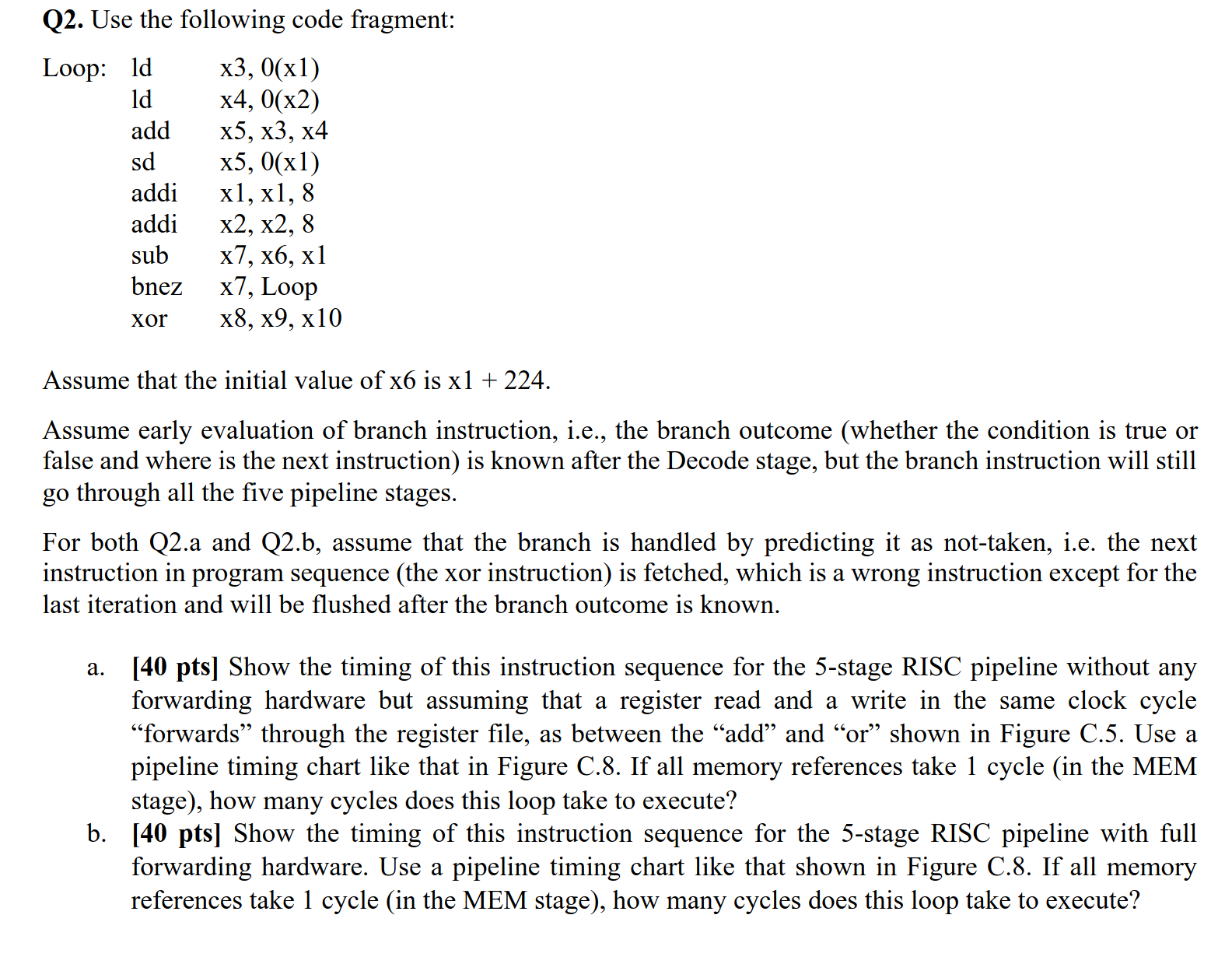
Show the timing of this instruction sequence for the 5-stage RISC pipeline without any forwarding hardware but assuming that a register read and a write in the same clock cycle “forwards” through the register file, as between the “add” and “or” shown in Figure C.5. Use a pipeline timing chart like that in Figure C.8. If all memory references take 1 cycle (in the MEM stage), how many cycles does this loop take to execute?
Answer:
| Instruction | C1 | C2 | C3 | C4 | C5 | C6 | C7 | C8 | C9 | C10 | C11 | C12 | C13 | C14 | C15 | C16 | C17 | C18 | C19 | C20 | C21 | C22 |
|---|---|---|---|---|---|---|---|---|---|---|---|---|---|---|---|---|---|---|---|---|---|---|
| ld x3,0(x1) | IF | ID | EX | ME | WB | |||||||||||||||||
| ld x4,0(x2) | IF | ID | EX | ME | WB | |||||||||||||||||
| add x5,x3,x4 | IF | ID | st | st | EX | ME | WB | |||||||||||||||
| sd x5,0(x1) | IF | st | st | ID | st | st | EX | ME | WB | |||||||||||||
| addi x2,x2,8 | IF | st | st | st | st | st | ID | EX | ME | WB | ||||||||||||
| sub x7,x6,x1 | IF | st | st | st | st | st | ID | st | EX | ME | WB | |||||||||||
| bnez x7,Loop | IF | st | st | st | st | st | ID | st | st | st | EX | ME | WB | |||||||||
| xor x8,x9,x10 | IF | st | st | st | st | st | st | st | st | ID | FL | EX | ME | WB | ||||||||
| ld x3,0(x1) (i2) | IF | ID |
- The loop runs for
28iterations - Iterations 1-27 has
17cycles:17 * 27 = 459cycles - Iteration 28:
21cycles
Total number of cycles: 459 + 21 = 480
b.)
Show the timing of this instruction sequence for the 5-stage RISC pipeline with full forwarding hardware. Use a pipeline timing chart like that shown in Figure C.8. If all memory references take 1 cycle (in the MEM stage), how many cycles does this loop take to execute?
Answer:
| Instruction | C1 | C2 | C3 | C4 | C5 | C6 | C7 | C8 | C9 | C10 | C11 | C12 | C13 | C14 | C15 |
|---|---|---|---|---|---|---|---|---|---|---|---|---|---|---|---|
| ld x3,0(x1) | IF | ID | EX | ME | WB | ||||||||||
| ld x4,0(x2) | IF | ID | EX | ME | WB | ||||||||||
| add x5,x3,x4 | IF | ID | st | EX | ME | WB | |||||||||
| sd x5,0(x1) | IF | st | ID | EX | ME | WB | |||||||||
| addi x1,x1,8 | IF | st | ID | EX | ME | WB | |||||||||
| addi x2,x2,8 | IF | st | ID | EX | ME | WB | |||||||||
| sub x7,x6,x1 | IF | st | ID | EX | ME | WB | |||||||||
| bnez x7,Loop | IF | st | ID | EX | ME | WB | |||||||||
| xor x8,x9,x10 | IF | st | ID | FL | EX | ME | WB | ||||||||
| ld x3,0(x1) (i2) | IF | ID | EX |
- The loop runs for
28iterations - Iterations 1-27 has
10cycles:10 * 27 = 270cycles - Iteration 28:
14cycles
Total: 270 + 14 = 284 cycles