Homework 3

Published on October 1, 2025

problem 1

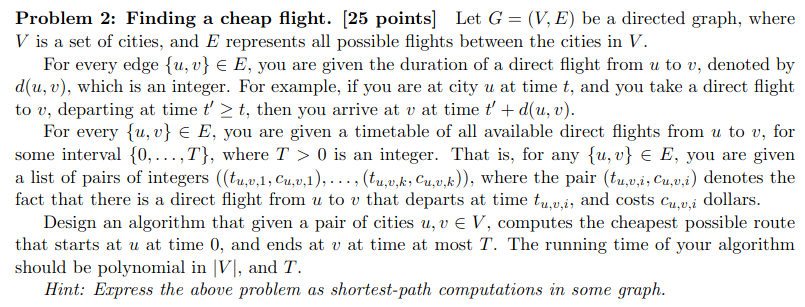
For each edge (u,v)E:(u,v)w(v),(v,u)w(u).Initialize:pqCreate-Priority-Queue(),π(v) for all vs,π(s)0,insert each vV into pq with key π(v).While pq is not empty:uDEL-MIN(pq).For each edge (u,v)E leaving u:if π(v)>π(u)+(u,v) thenDECREASE-KEY(pq,v,π(u)+(u,v)),π(v)π(u)+(u,v),pred(v)u.Reconstruct shortest path:shortestPath,currt;while currs:prepend curr to shortestPath,currpred(curr);prepend s to shortestPath.\begin{aligned} &\text{For each edge }(u,v)\in E:\\ &\qquad \ell(u,v) \gets w(v),\quad \ell(v,u) \gets w(u).\\[6pt] &\text{Initialize:}\\ &\qquad pq \gets \texttt{Create-Priority-Queue}(),\\ &\qquad \pi(v) \gets \infty\ \text{for all }v\neq s,\quad \pi(s)\gets 0,\\ &\qquad \text{insert each }v\in V\text{ into }pq\text{ with key }\pi(v).\\[6pt] &\text{While }pq\text{ is not empty:}\\ &\qquad u \gets \texttt{DEL-MIN}(pq).\\ &\qquad\text{For each edge }(u,v)\in E\text{ leaving }u:\\ &\qquad\qquad\text{if }\pi(v) > \pi(u) + \ell(u,v)\text{ then}\\ &\qquad\qquad\qquad \texttt{DECREASE-KEY}(pq, v, \pi(u)+\ell(u,v)),\\ &\qquad\qquad\qquad \pi(v) \gets \pi(u) + \ell(u,v),\quad \operatorname{pred}(v) \gets u.\\[6pt] &\text{Reconstruct shortest path:}\\ &\qquad \texttt{shortestPath} \gets \varnothing,\quad curr \gets t;\\ &\qquad \text{while }curr \neq s:\\ &\qquad\qquad \text{prepend }curr\text{ to }\texttt{shortestPath},\quad curr \gets \operatorname{pred}(curr);\\ &\qquad \text{prepend }s\text{ to }\texttt{shortestPath}. \end{aligned}

problem 2

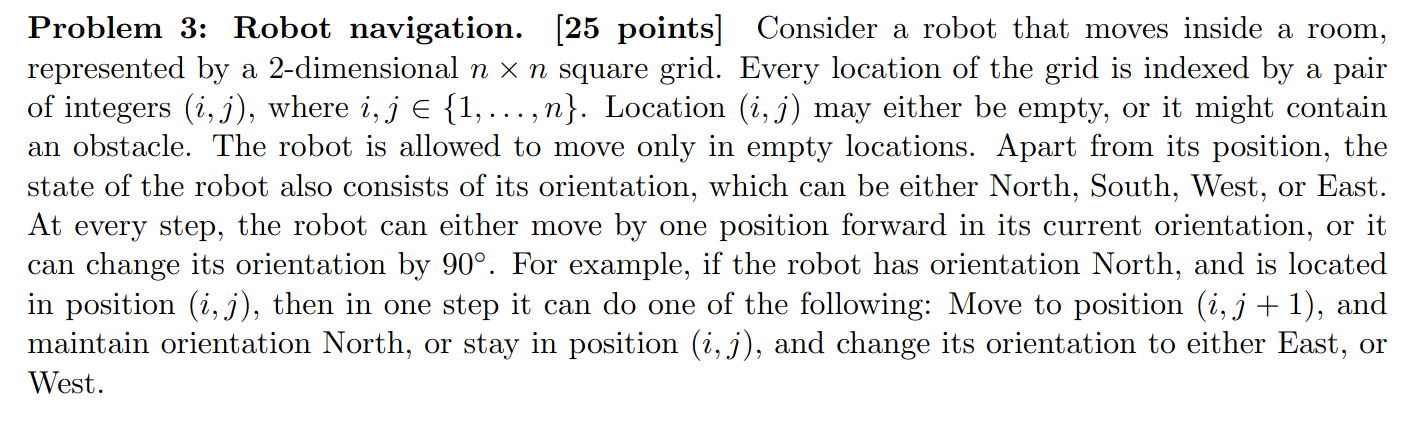
Create a new graph G=(V,E) with (city, time) pairs as verticesBuild vertices:FOREACH vertex cV:FOR t=0 to T:Add pair (c,t) to VAdd flight edges:FOREACH edge (u,v)E:FOREACH flight (departure_time,cost)timetable[u][v]:arrival_time=departure_time+d(u,v)IF arrival_timeT:Add ((u,departure_time),(v,arrival_time),cost) to EAdd waiting edges:FOREACH vertex cV:FOR t=0 to T1:Add ((c,t),(c,t+1),0) to ERun Dijkstra on G:distances, predecessors=Dijkstra(G,(s,0))Find minimum cost and destination node:min_cost=final_destination_node=nullFOR t=0 to T:IF distances[(v,t)]<min_cost:min_cost=distances[(v,t)]final_destination_node=(v,t)Backtrack to get the cheapest route :route=new Listcurrent_node=final_destination_nodeWHILE current_nodenull:Add current_node to the front of the route listcurrent_node=predecessors[current_node]Return route\begin{align*} & \text{Create a new graph } G' = (V', E') \text{ with (city, time) pairs as vertices} \\ & \\ &\text{Build vertices:}\\ & \qquad\textbf{FOREACH } \text{vertex } c \in V: \\ & \qquad\qquad \textbf{FOR } t = 0 \text{ to } T: \\ & \qquad\qquad\qquad \text{Add pair } (c, t) \text{ to } V' \\ & \\ &\text{Add flight edges:}\\ & \qquad\textbf{FOREACH } \text{edge } (u, v) \in E: \\ & \qquad\qquad \textbf{FOREACH } \text{flight } (\text{departure\_time}, \text{cost}) \in \text{timetable}[u][v]: \\ & \qquad\qquad \text{arrival\_time} = \text{departure\_time} + d(u, v) \\ & \qquad\qquad \textbf{IF } \text{arrival\_time} \leq T: \\ & \qquad\qquad\qquad \text{Add } ((u, \text{departure\_time}), (v, \text{arrival\_time}), \text{cost}) \text{ to } E' \\ & \\ & \text{Add waiting edges:}\\ & \qquad\textbf{FOREACH } \text{vertex } c \in V: \\ & \qquad\qquad \textbf{FOR } t = 0 \text{ to } T - 1: \\ & \qquad\qquad \text{Add } ((c, t), (c, t+1), 0) \text{ to } E' \\ & \\ & \text{Run Dijkstra on }G': \\ & \qquad \text{distances, predecessors} = \text{Dijkstra}(G', (s, 0)) \\ & \\ & \text{Find minimum cost and destination node}: \\ & \qquad\text{min\_cost} = \infty \\ & \qquad\text{final\_destination\_node} = \text{null} \\ & \qquad\textbf{FOR } t = 0 \text{ to } T: \\ & \qquad\quad \textbf{IF } \text{distances}[(v, t)] < \text{min\_cost}: \\ & \qquad\qquad \text{min\_cost} = \text{distances}[(v, t)] \\ & \qquad\qquad \text{final\_destination\_node} = (v, t) \\ & \\ & \text{Backtrack to get the cheapest route }: \\ & \qquad\text{route} = \text{new List} \\ & \qquad\text{current\_node} = \text{final\_destination\_node} \\ & \qquad\textbf{WHILE } \text{current\_node} \neq \text{null}: \\ & \qquad\quad \text{Add } \text{current\_node} \text{ to the front of the route list} \\ & \qquad\quad \text{current\_node} = \text{predecessors}[\text{current\_node}] \\ & \\ & \textbf{Return } \text{route} \end{align*}

problem 3

a.)

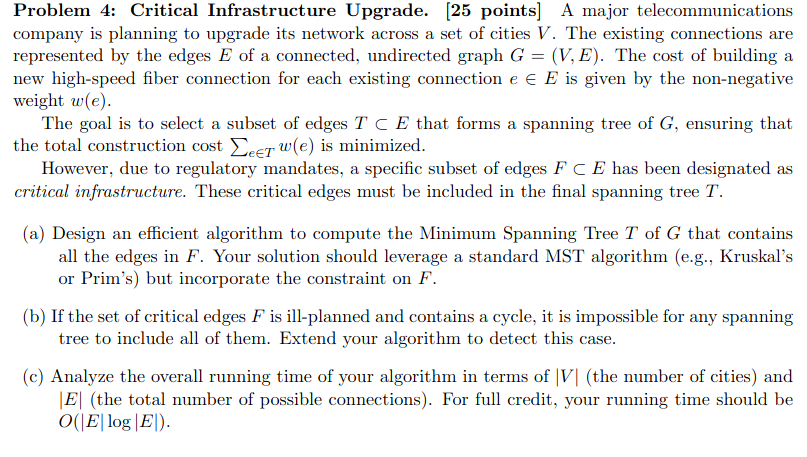
Initialization:For all states (i,j,dir):dist[i,j,dir],pred[i,j,dir]null.Set dist[1,1,North]0.PQCreate-Min-PQ(),insert every state (i,j,dir) into PQ with key dist[].Main loop:while PQ is not empty:uEXTRACT-MIN(PQ)(where u=(i,j,dir)).For each valid neighbor state v of u (forward, left, right):if dist[u]+1<dist[v] thendist[v]dist[u]+1,pred[v]u,DECREASE-KEY(PQ,v,dist[v]).Find the solution:d=min{dist[n,n,North],dist[n,n,East],dist[n,n,South],dist[n,n,West]}.If d= then the goal is unreachable. Otherwise, reconstruct the shortest path by backtracking from thestate among {(n,n,)} with value d using the pred pointers.\begin{aligned} &\textbf{Initialization:}\\ &\qquad \text{For all states }(i,j,dir):\quad \text{dist}[i,j,dir]\gets\infty,\quad \text{pred}[i,j,dir]\gets\text{null}.\\ &\qquad \text{Set }\text{dist}[1,1,\text{North}]\gets 0.\\ &\qquad \text{PQ}\gets\texttt{Create-Min-PQ}(),\quad \text{insert every state }(i,j,dir)\text{ into PQ with key }\text{dist}[\cdot].\\[6pt] &\textbf{Main loop:}\\ &\qquad \text{while }\text{PQ}\text{ is not empty:}\\ &\qquad\qquad u\gets\texttt{EXTRACT-MIN}(\text{PQ})\quad\text{(where }u=(i,j,dir)\text{)}.\\ &\qquad\qquad \text{For each valid neighbor state }v\text{ of }u\text{ (forward, left, right):}\\ &\qquad\qquad\qquad \text{if }\text{dist}[u]+1<\text{dist}[v]\text{ then}\\ &\qquad\qquad\qquad\qquad \text{dist}[v]\gets\text{dist}[u]+1,\quad \text{pred}[v]\gets u,\\ &\qquad\qquad\qquad\qquad \texttt{DECREASE-KEY}(\text{PQ},v,\text{dist}[v]).\\[6pt] &\textbf{Find the solution:}\\ &\qquad d^*=\min\{\text{dist}[n,n,\text{North}],\text{dist}[n,n,\text{East}],\text{dist}[n,n,\text{South}],\text{dist}[n,n,\text{West}]\}.\\ &\qquad \text{If }d^*=\infty\text{ then the goal is unreachable. Otherwise, reconstruct the shortest path by backtracking from the} \\ &\qquad \text{state among }\{(n,n,*)\}\text{ with value }d^*\text{ using the }\text{pred}\text{ pointers.} \end{aligned}

b.)

Initialization:QCreate-Queue(),enqueue(Q,start_state),dist[start_state]0,pred[start_state]null.Main loop (BFS over joint states):while Q is not empty:Ucurrdequeue(Q).if Ucurr is the goal state thenreconstruct and return path by backtracking using pred (length dist[Ucurr]).Generate all combined moves M (size 3k) for the k robots.for each mM:Unextapply(m,Ucurr).Check validity: Unext is valid if(i) every robot position is in-bounds,(ii) no robot is on a static obstacle,(iii) no two robots occupy the same cell,(iv) no two robots swap positions in this step.If Unext is valid and not visited:dist[Unext]dist[Ucurr]+1,pred[Unext]Ucurr,enqueue(Q,Unext).Termination:If the loop ends without reaching the goal, return “No path exists.”\begin{aligned} &\textbf{Initialization:}\\ &\qquad Q\gets\texttt{Create-Queue}(),\quad \text{enqueue}(Q,\text{start\_state}),\\ &\qquad \text{dist}[\text{start\_state}]\gets 0,\quad \text{pred}[\text{start\_state}]\gets \text{null}.\\[6pt] &\textbf{Main loop (BFS over joint states):}\\ &\qquad \text{while }Q\text{ is not empty:}\\ &\qquad\qquad U_{curr}\gets\text{dequeue}(Q).\\ &\qquad\qquad \text{if }U_{curr}\text{ is the goal state then}\\ &\qquad\qquad\qquad \text{reconstruct and return path by backtracking using }\text{pred}\text{ (length }\text{dist}[U_{curr}]\text{)}.\\[6pt] &\qquad\qquad \text{Generate all combined moves }M\text{ (size }3^k\text{) for the }k\text{ robots.}\\ &\qquad\qquad \text{for each }m\in M:\\ &\qquad\qquad\qquad U_{next}\gets\text{apply}(m,U_{curr}).\\ &\qquad\qquad\qquad \text{Check validity: }U_{next}\text{ is valid if} \\ &\qquad\qquad\qquad\qquad\text{(i) every robot position is in-bounds,}\\ &\qquad\qquad\qquad\qquad\text{(ii) no robot is on a static obstacle,}\\ &\qquad\qquad\qquad\qquad\text{(iii) no two robots occupy the same cell,}\\ &\qquad\qquad\qquad\qquad\text{(iv) no two robots swap positions in this step.}\\ &\qquad\qquad\qquad \text{If }U_{next}\text{ is valid and not visited:}\\ &\qquad\qquad\qquad\qquad \text{dist}[U_{next}]\gets\text{dist}[U_{curr}]+1,\\ &\qquad\qquad\qquad\qquad \text{pred}[U_{next}]\gets U_{curr},\\ &\qquad\qquad\qquad\qquad \text{enqueue}(Q,U_{next}).\\[6pt] &\textbf{Termination:}\\ &\qquad \text{If the loop ends without reaching the goal, return ``No path exists.''} \end{aligned}

problem 4

a & b

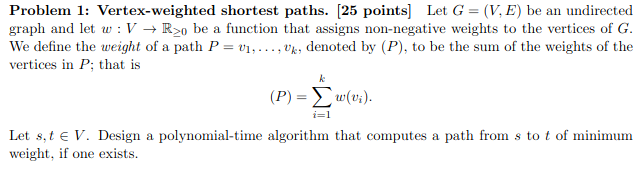
Initialize:Make a disjoint-set (Union-Find) UF with a separate set for each vV,T.Process critical edges F:for each (u,v)F:if findUF(u)=findUF(v)error: critical edges in F form a cycle,elseTT{(u,v)},unionUF(u,v).Process remaining edges:REF,sort R by non-decreasing weight,for each (u,v)R:if findUF(u)findUF(v) thenTT{(u,v)},unionUF(u,v).Return: T.\begin{aligned} &\textbf{Initialize:}\\ &\qquad \text{Make a disjoint-set (Union-Find) }UF\text{ with a separate set for each }v\in V,\\ &\qquad T\gets\varnothing.\\[6pt] &\textbf{Process critical edges }F:\\ &\qquad \text{for each }(u,v)\in F:\\ &\qquad\qquad \text{if }\operatorname{find } {UF}(u)=\operatorname{find } {UF}(v)\\ &\qquad\qquad\qquad \text{\textbf{error}: critical edges in }F\text{ form a cycle},\\ &\qquad\qquad \text{else}\\ &\qquad\qquad\qquad T\gets T\cup\{(u,v)\},\quad \operatorname{union } {UF}(u,v).\\[6pt] &\textbf{Process remaining edges:}\\ &\qquad R\gets E\setminus F,\\ &\qquad \text{sort }R\text{ by non-decreasing weight},\\ &\qquad \text{for each }(u,v)\in R:\\ &\qquad\qquad \text{if }\operatorname{find} {UF}(u)\neq\operatorname{find} {UF}(v)\text{ then}\\ &\qquad\qquad\qquad T\gets T\cup\{(u,v)\},\quad \operatorname{union} {UF}(u,v).\\[6pt] &\textbf{Return: }T. \end{aligned}

c.)

  • Processing Critical Edges

    • There are |F| critical edges
    • loop through each edges and perform union-find
    • union-find is nearly constant time on average
    • Since F is a subset of E it will take at most O(|E|) time
  • Sorting the Remaining Edges:

    • Sorting the edges that are not in F. |E| - |F| which is in the order of O(|E|)
    • To sort the remaining edges it will take O(|E|log|E|) time
  • Looping through Remaining Edges:

    • This will take approximately O(|E|) time.

Combining these gives the total time of O(|E|) + O(|E|log|E|) + O(|E|). The dominant term is O(|E|log|E|) which give the overall running time of the algorithm.